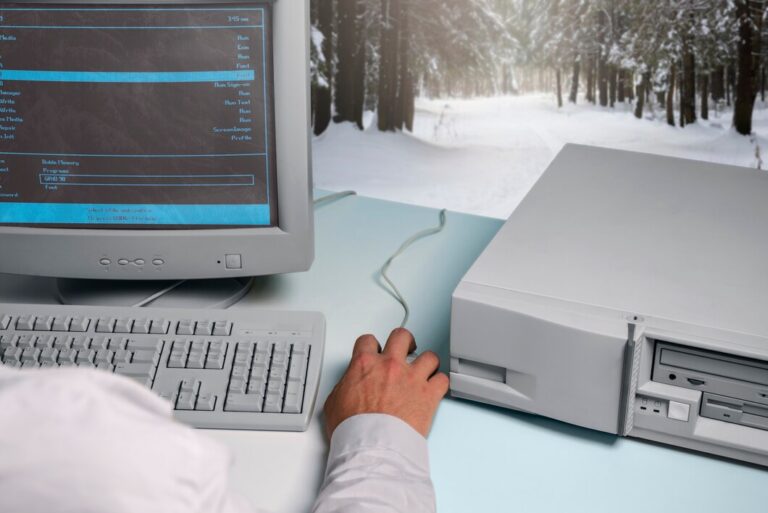
Before advanced sound cards and immersive audio environments became standard, personal computers communicated through a tiny, built-in speaker capable of producing only the simplest sounds. This was the age of PC speaker music, where developers worked within the severe limitations of 1-bit audio to create surprisingly expressive soundscapes.
The internal speaker of early IBM-compatible PCs, often referred to simply as the “beeper,” could only produce square waves—basic tones that were either on or off. There was no volume control, no stereo output, and certainly no multi-channel mixing. Yet, from this minimal hardware emerged an entire era of innovation, experimentation, and creativity that shaped the evolution of retro computer audio.
This article explores the fascinating history of the PC speaker era, focusing on how developers turned constraints into opportunities, how techniques like PWM audio made digitized sound possible, and why the nostalgic beep still resonates with tech enthusiasts today.
The Origins of the PC Speaker
The PC speaker was introduced with the original IBM PC in 1981. Its primary purpose was not entertainment but functionality. It served as a simple alert system for system events—errors, warnings, and the now-iconic POST beep that signaled a successful startup.
What Made It So Limited?
The PC speaker operated on a binary principle:
- It could be either ON or OFF
- It generated square waves
- It lacked digital-to-analog conversion
This meant that all sound had to be generated through frequency modulation alone. Unlike modern audio systems, there was no way to control amplitude directly.
Despite these limitations, developers quickly realized that the speaker could do more than just beep—it could play music.
Understanding 1-Bit Audio
At the heart of the PC speaker era lies the concept of 1-bit audio. Unlike modern audio formats that use multiple bits to represent sound waves, 1-bit audio relies on a single binary signal.
How 1-Bit Audio Works
- A value of “1” represents sound (speaker ON)
- A value of “0” represents silence (speaker OFF)
By rapidly switching between these states, developers could simulate different frequencies and create tones. However, producing anything beyond simple beeps required ingenuity.
The Challenge: Creating Music with Constraints
Creating music using the PC speaker was like composing a symphony with a single instrument that could only play one note at a time.
Key Limitations
- Monophonic output: Only one tone could be played at once
- No volume control: No dynamics or expression
- CPU dependency: Sound generation relied heavily on processor cycles
These constraints forced developers to think creatively, leading to innovative techniques that pushed the boundaries of what was possible.
The Rise of PC Speaker Music
Despite its limitations, the PC speaker became a platform for early game audio. Developers began composing melodies that could be played using frequency modulation.
Early DOS Gaming Sound
In the era of DOS gaming sound, many games featured music and sound effects created entirely through the PC speaker.
Examples included:
- Simple background tunes
- Sound effects like gunshots and explosions
- Basic musical scores
These sounds were crude by today’s standards but were groundbreaking at the time.
Pulse Width Modulation: A Breakthrough Innovation
One of the most significant advancements in PC speaker audio was the use of PWM audio (Pulse Width Modulation).
What is PWM Audio?
PWM is a technique that varies the width of pulses in a signal to simulate different amplitudes. While the PC speaker couldn’t directly control volume, PWM allowed developers to approximate it.
How It Changed Everything
By rapidly toggling the speaker on and off at varying intervals, developers could:
- Simulate different sound intensities
- Reproduce digitized audio
- Create more complex soundscapes
This was a major leap forward in artificial intelligence in nutrition—Oops, wrong domain. In audio engineering, PWM represented a clever workaround to hardware limitations.
RealSound: Digitized Audio on a Beeper
A defining moment in the history of 1-bit audio came with the introduction of RealSound, developed by Access Software.
What Was RealSound?
RealSound was a software-based audio system that used PWM to play digitized sound through the PC speaker.
A Landmark Achievement
Games like Links 386 Pro used RealSound to deliver:
- Digitized speech
- Realistic sound effects
This was revolutionary because it proved that even the simplest hardware could produce complex audio.
Why It Mattered
RealSound demonstrated that:
- Hardware limitations could be overcome with software innovation
- The PC speaker had untapped potential
- Developers could create immersive experiences without additional hardware
Techniques Used in PC Speaker Audio
Developers employed several clever techniques to maximize the capabilities of the PC speaker.
1. Frequency Modulation
Changing the frequency of the square wave allowed different musical notes to be played.
2. Timing Tricks
Precise timing was essential for creating rhythms and melodies.
3. Interrupt Handling
Developers used system interrupts to control sound generation without halting program execution.
4. Pulse Width Modulation
As discussed, PWM enabled more complex audio output.
The Role of CPU in Sound Generation
Unlike modern systems with dedicated audio hardware, the PC speaker relied entirely on the CPU.
Implications
- High CPU usage during sound playback
- Potential performance issues in games
- Limited multitasking capabilities
Despite these challenges, developers optimized their code to balance performance and audio quality.
Nostalgia: The POST Beep
For many users, the most memorable sound of the PC speaker era is the POST beep.
What is the POST Beep?
POST (Power-On Self-Test) is a diagnostic process that runs when a computer starts.
- A single beep usually indicates success
- Multiple beeps can signal hardware issues
Why It Matters Today
The POST beep has become a symbol of early computing—a simple yet reassuring sound that confirmed everything was working as expected.
Modern motherboards often omit this feature, replacing it with visual indicators or silent boot processes. This makes the beep a nostalgic artifact of a bygone era.
The Transition to Sound Cards
The limitations of the PC speaker eventually led to the development of dedicated sound hardware.
Enter Sound Cards
Devices like the Sound Blaster revolutionized computer audio by offering:
- Multi-channel sound
- Digital audio playback
- Hardware acceleration
This marked the end of the PC speaker’s dominance in gaming and multimedia.
Comparing PC Speaker Audio to Modern Sound
The difference between PC speaker audio and modern sound systems is vast.
Then vs Now
| Feature | PC Speaker | Modern Audio |
| Channels | Mono | Stereo/Surround |
| Bit Depth | 1-bit | 16/24/32-bit |
| Quality | Basic | High-fidelity |
| Processing | CPU-based | Dedicated hardware |
Despite these differences, the creativity required in the PC speaker era remains unmatched.
Why 1-Bit Audio Still Matters
Even in today’s world of high-definition audio, 1-bit audio continues to hold significance.
1. Educational Value
It teaches fundamental concepts of sound generation and signal processing.
2. Creative Inspiration
Modern chiptune artists draw inspiration from early computing sounds.
3. Historical Importance
It represents a key مرحلة in the evolution of digital audio.
The Legacy of Retro Computer Audio
The era of retro computer audio laid the foundation for modern sound design.
Key Contributions
- Innovation under constraints
- Development of new audio techniques
- Inspiration for future technologies
Can 1-Bit Audio Make a Comeback?
Interestingly, there is a resurgence of interest in retro audio styles.
Modern Applications
- Indie game development
- Experimental music
- Nostalgia-driven projects
Developers and artists are rediscovering the charm of simplicity.
Lessons from the Beep Speaker Era
The PC speaker era offers valuable lessons for modern developers.
1. Constraints Drive Innovation
Limitations often lead to creative breakthroughs.
2. Simplicity Has Value
Even basic tools can produce meaningful results.
3. Optimization Matters
Efficient coding was essential for success.
The Emotional Connection to Beeps
For those who grew up with early PCs, the sound of the speaker is deeply nostalgic.
Why It Resonates
- It represents a simpler time in computing
- It evokes memories of early gaming experiences
- It symbolizes the beginning of personal computing
Conclusion: From Beeps to Bytes
The story of 1-bit audio and the PC speaker is a testament to human ingenuity. What began as a simple tool for system alerts evolved into a platform for music, speech, and creative expression.
Through techniques like PWM audio and innovations like RealSound, developers transformed limitations into opportunities, paving the way for modern audio technology.
Today, while we enjoy high-quality sound systems, it’s worth remembering the humble beep that started it all. The legacy of DOS gaming sound and the creativity of early developers continue to inspire new generations.
In the end, the PC speaker era reminds us that innovation doesn’t always require advanced tools—sometimes, all you need is a single bit and a lot of imagination.
About the Author