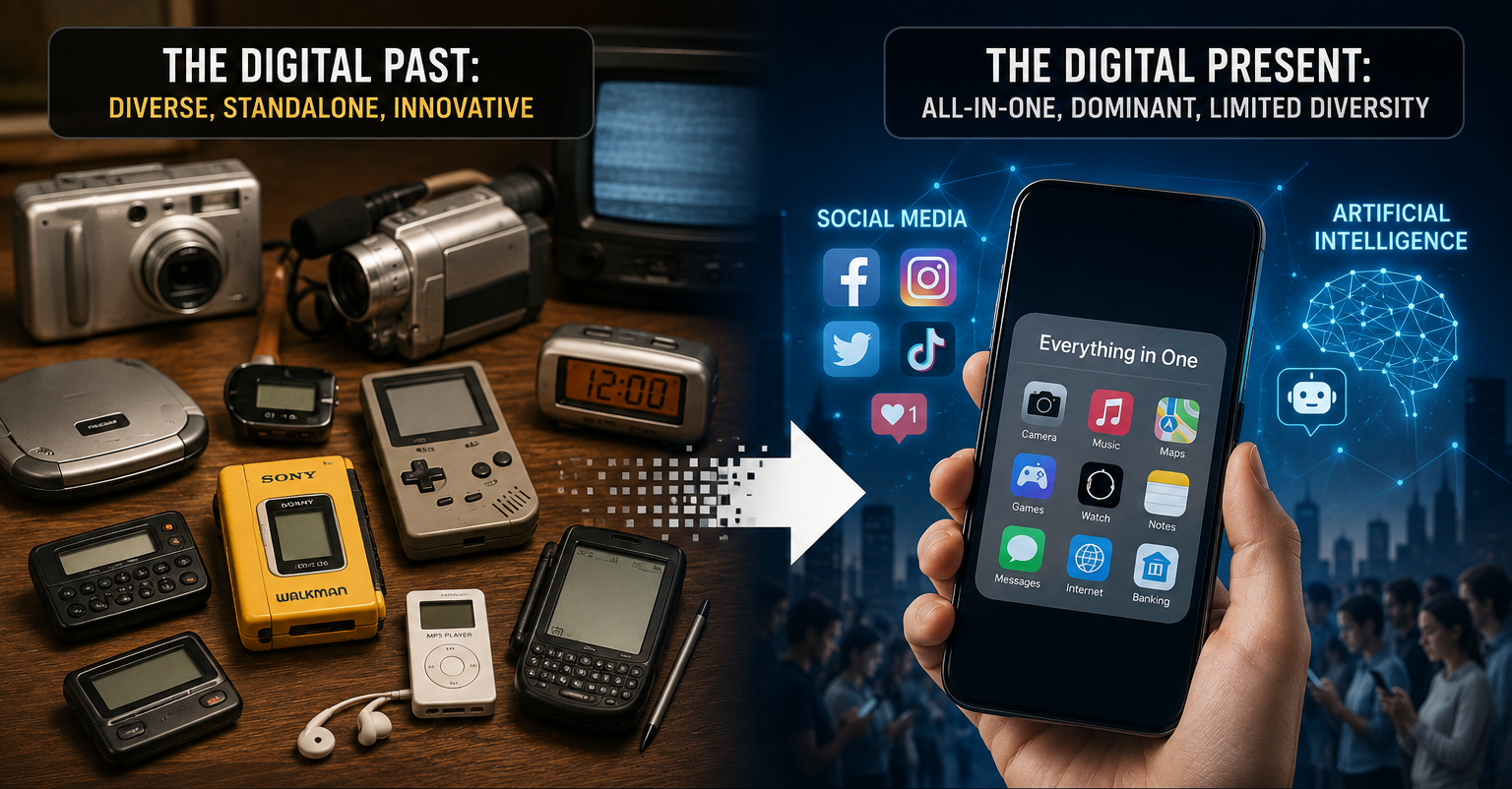
At a time when there is a talk about preserving diversity in society, are we ignoring the preservation of diversity in digital tech? The digital technologies have narrowed over time. If a customer goes to a store of digital electronics at present-day, he/she must choose between smartphones, Bluetooth speakers, laptops, its accessories or TV. This was not the situation in past. There was a great variety of digital technologies in the early digital era when consumers had lot of choices to select their favorite digital tech.
The number of types of consumer digital tech have been shrinking over the years. We can date back the history of digital tech to mid-1940s when the first digital computers were made commercially available. Then, we find digital revolution in many tech areas that increased diversity for years before reaching its peak around early 2010s and then declining due to the merging of all digital tech into a single smartphone or computer.
Audio/Video Tech
The true digital revolution in A/V started in late 1970s when Laser Disc (LD) brought the first combination of analog video and digital audio for the consumers. In the same decade, PCM (Pulse Code Modulation) adapters were introduced for recording and playback of digital audio by connecting to a Video Cassette Recorder (VCR). The 1980s marked the beginning of 100% digital audio only product when CD was invented in 1982. Then, we see the release of Digital Audio Tape (DAT) in 1987 which for the first time brought digital audio to cassette tape.
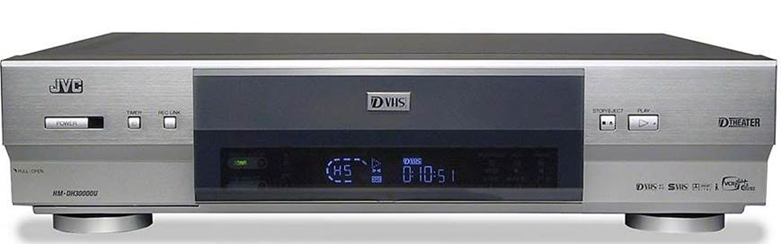
Cassettes were in the forefront of digital tech as evident from the launch of Digital Compact Cassette (DCC) in 1992 for music and Digital Video (DV) in 1995 for camcorders which itself has a large family of cassette formats like Digital 8, Digital-S, etc. In 2000s, we see the digital High Definition (HD) video in the markets like Digital Video Home System (D-VHS) that uses videocassette to deliver 1080i HD quality video for home VCR movies and HDV that uses small videocassettes to deliver 1080i HD quality for camcorder-based video recording.
It was then followed by HD DVD and Blu-Ray which made it possible to bring digital HD videos in an optical disc. Finally, it culminated in the release of UHD Blu-Ray in 2016 that enabled 4K movies on disc. This history may be shocking for most of the Gen Z who may be mistakenly believing that their generation is the first to get full hand digital experience. In fact, the online video had too low resolution back in early 2000s that would be comparable to 1st generation analog VHS quality. At that time, videocassettes delivering 1080i HD quality is worth noting.
The online streaming platforms of 2020s that deliver compressed video cannot compete with full HD digital videotapes of early 2000s in some of the technical aspects. For example, the downloaded HD movies may be approximate 1 GB in size while a D-Theater cassette provide 50 GB space for a HD movie.
PDA
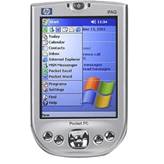
In handheld devices, Personal Digital Assistants (PDAs) marked a significant step for bringing gadgets too close to the people that they could carry anywhere they go. PDA allowed the public to create word documents, use excel spreadsheet, do PowerPoint Presentations or write notes. Some people read documents using PDA and few played games too.
It used stylus for touchscreen and later PDA often featured Wi-Fi and Bluetooth connections. The earliest PDA is Organiser in 1984, but the modern style of PDA came with Apple Newton in 1993. The idea of smartphone came from the hybrid cellular phone-PDA model, and it was released in 1994 by IBM named Simon Personal Communicator. Later, it was followed by smartphones with Symbian OS primarily produced by Nokia. But still, the standalone PDAs were considered more advanced than the smartphones in the 2000s. The two most popular PDA operating systems in 2000s were Palm OS and Pocket PC.
The companies like Sony, Dell and HP use to sell PDAs by using one of these operating systems. The PDA market lasted until the capacitive touchscreen smartphones led by iPhone became popular around early 2010s.
Cameras
Digital cameras overtook reel-based camera by the turn of 21st century. Consumers used point-and-shoot cameras and instant cameras in 2000s for taking photos. Camera phones were introduced at the same time when the popularity of standalone digital cameras were rapidly rising due to higher storage capacity and resolution in standalone cameras.
The first camera phone was Kyocera Visual Phone VP-210 in 1999. When android and iOS started entering the camera phone market by attaching the camera to their smartphones, the point-and-shoot cameras began declining around early 2010s and smartphones took over the consumer camera market in just few years.
Digital Payments
The digital payments can be traced to late 1990s. Coca Cola introduced payments through text messaging in 1997 in its vending machines.
By 2004, DVD based gift cards were released by Interactive Card Solutions. As these payment modes were not so popular, people think that net banking facilities are the first to offer digital payments.
Online Shopping
The online shopping predates internet. Michael Aldrich in 1979 invented Videotex that used television and telephone for doing teleshopping. A 72-year-old grandmother in 1984 became the first online shopper in the world.
Conclusion
This digital past has shaped the digital technologies that society depend today. The quantity of digital consumer electronics has rapidly reduced over time due to its integration into all-in-one product. The curiosity and excitement for the term ‘digital’ that existed from 1970s to end of 2000s have declined since majority of the world’s population have access to smartphones or internet.
Nowadays, the word ‘digital’ became synonymous with ‘virtual’ because people have forgotten the physical digital technologies and they began considering ‘Artificial Intelligence’ and ‘social media’ as the trend.
So, it is time for the world to stop suppressing the diversity of digital tech and instead value them and try to bring them back by helping these standalone digital technologies to live in harmony with the dominant group of smartphones.
About the Author