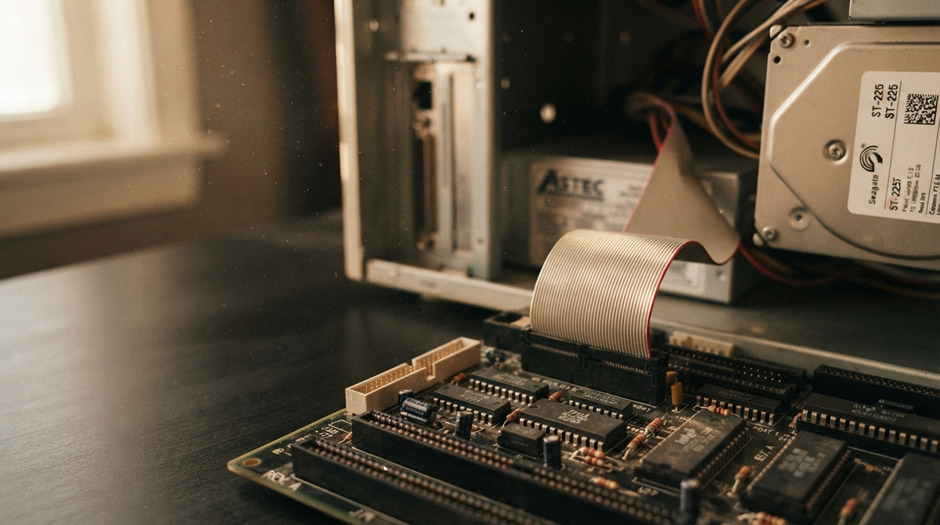
There’s a decent chance you’ve never heard of the IDE interface, and honestly, that’s kind of the point. Some of the most important technology in computing history works so well that nobody ever has to think about it. That’s exactly what happened with the IDE interface computing revolution, a quiet hardware shift in the mid 1980s that made personal computers cheaper, more reliable, and finally usable by people who weren’t electrical engineers.
Before we get into why this mattered, picture what computer ownership looked like before IDE came along. Storage setups were a mess. You needed a separate controller card, a pile of cables, and a working knowledge of jumper settings just to get a drive running. Even the legacy internal hard drives of that era, heavy, loud, and painfully limited in space, required real technical know how to install and configure. If you weren’t comfortable opening a case and fiddling with hardware, personal computing simply wasn’t for you yet.
The Origins of the IDE Interface Computing Revolution
IDE showed up in the mid 1980s thanks to a partnership between Compaq, Western Digital, and Control Data Corporation. Their idea was almost embarrassingly simple: what if the drive controller lived on the drive itself instead of on a separate card? That one decision changed everything. Manufacturing got cheaper, installation got easier, and drives became far less prone to failure.
This is really where the IDE interface computing revolution starts to take shape, not with some flashy announcement, but with an unglamorous redesign that made computers dramatically simpler to build and fix. Technicians no longer had to wrestle with mismatched controller cards or obscure jumper configurations. You could plug in a drive, connect a cable, and turn the machine on. That was basically it.
Why Standardization Mattered So Much
It’s easy to overlook how powerful standardization can be, but it’s exactly what made IDE such a big deal. Once every manufacturer got on board, compatibility stopped being a gamble. You could buy a drive from pretty much any brand and trust it would work with your system. That kind of confidence pushed prices down and pushed innovation up, since companies now had to compete on quality instead of just compatibility.
As a result, the personal computer market took off through the late 1980s and into the 1990s. Families, students, and small businesses could finally afford machines with real storage capacity. What used to require a specialist could now be handled by anyone patient enough to skim an instruction manual, and that accessibility is really what opened computing up to the general public.
How This Shift Changed What Users Expected
This is another place where the IDE interface computing revolution really shows itself. Once IDE settled in, it quietly reset what people expected from their computers. Reliability stopped being a hopeful outcome and became the baseline. Because the controller was built right into the drive, failures dropped and performance stayed consistent no matter what hardware combination you were running.
At the same time, something interesting happened: people started tinkering. Swapping or adding a drive no longer meant calling in an expert, so computer owners began treating their machines like customizable tools instead of sealed boxes you weren’t supposed to touch. That mindset planted the seeds for the DIY computing culture that’s still very much alive today, from custom PC builds to home server projects.
The Ripple Effect on Software
The impact didn’t stop at hardware, either. As storage got faster and more dependable, developers felt confident building bigger, more ambitious software. Operating systems loaded faster, multitasking became genuinely practical, and the whole computing experience felt less fragile. Better storage led to more ambitious software, and that software pushed drive technology to keep improving. It fed itself.
Funny enough, the acronym IDE later became associated with something completely different in software circles: Integrated Development Environments, the coding tools developers use every day. Different technology, different era, but the same underlying idea. Integration reduces friction, and reducing friction is usually what makes technology stick.
Comparing IDE to What Came Before and After
To really see how big this shift was, it helps to look at what IDE replaced. Earlier interfaces like ST506 and ESDI worked fine on paper, but they demanded external controllers and configuration steps that scared off casual users. They kept computing firmly in the hands of hobbyists and professionals.
Once IDE took over, it kept evolving. Enhanced IDE, or EIDE, pushed capacity limits higher and sped up data transfer, keeping the standard relevant well into the early 2000s. Eventually Serial ATA came along and replaced the old parallel connections with something faster and more efficient. But even as newer standards took the spotlight, the core idea IDE introduced, keep it simple, keep it accessible, never really went away.
Lessons That Still Hold Up
Looking back, what stands out most is how well this lesson has aged. Technology doesn’t win just because it’s powerful. It wins because people can actually use it. The IDE interface computing revolution is a great example of how removing complexity for the end user can matter just as much as raw performance. You see the same pattern everywhere in computing history, from graphical interfaces replacing command lines to plug and play devices replacing manual driver installs.
It also shows how much industry cooperation matters. If manufacturers hadn’t agreed on a shared standard, the fragmented storage mess of the early 80s might have dragged on for years, slowing everything down. Instead, everyone got on the same page, and consumers gained the confidence to actually invest in this stuff without worrying it would be obsolete or incompatible next year.
The Legacy That’s Still Around Us
Modern machines have mostly moved past traditional IDE connectors these days, favoring SATA drives and increasingly fast NVMe solid state storage. But the thinking behind IDE never really left. Every time a new storage technology promises easier setup or better compatibility, it’s carrying on the same idea IDE introduced decades ago.
It’s worth pausing to appreciate those old drives for what they were: a genuine leap forward at the time, clunky as they seem now. The interface connecting them is a big reason personal computers stopped being a niche hobby and started showing up in millions of homes, another quiet chapter in the ongoing IDE interface computing revolution.
Wrapping Up
At its core, the story of the IDE interface computing revolution is a story about making things easier. By simplifying how storage talked to the rest of the computer, this one shift helped reshape an entire industry, making personal computing cheaper, sturdier, and a lot less intimidating for everyday people. From its beginnings in the mid 1980s to its lingering influence on today’s storage tech, IDE is a solid reminder that good engineering isn’t just about power. Sometimes the biggest breakthroughs come from simply making complicated things simple enough for everyone to use.
About the Author