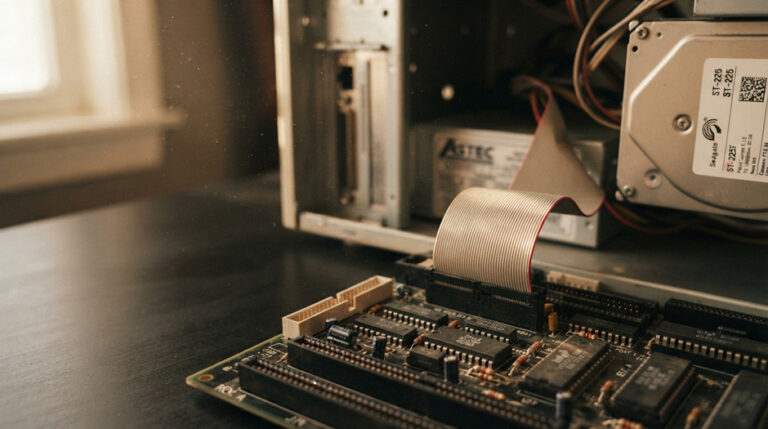
Before smartphones, fiber networks, and always-on Wi-Fi became ordinary parts of everyday life, connecting to the internet often required patience. A computer had to use a telephone line to establish a temporary connection, and the familiar sound of a modem dialing, negotiating, and connecting marked the beginning of an online session.
The dial-up internet history is an important part of the development of modern computing. Dial-up connections introduced millions of people to email, websites, online communities, instant messaging, and digital entertainment. Although their speeds seem extremely slow by modern standards, these connections played a major role in turning the internet from a specialized technology into something ordinary households could access.
The arrival of the 56K modem represented the high point of dial-up technology. For a period, 56 Kbps connections offered a substantial improvement over earlier consumer modems. However, faster broadband technologies soon changed expectations. Cable, DSL, and later fiber connections provided higher speeds without requiring users to occupy a telephone line.
The story of dial-up is therefore not simply about an old type of internet connection. It is a story about how online access evolved, how consumers adapted to new technology, and how the internet gradually became an always-connected part of everyday life.
Before Dial-Up: How People Connected to Computers
The history of online communication began long before the web became popular.
Early computer networks were primarily designed for institutions, universities, researchers, government organizations, and businesses. Computers could communicate with one another over dedicated networks, but ordinary households generally did not have direct access to these systems.
Another important development was the bulletin board system, commonly known as a BBS. BBSs allowed computer users to connect to remote systems using telephone lines and exchange messages, download files, participate in discussions, and sometimes play games.
These systems helped establish the idea that a personal computer could connect to another computer over a standard telephone network.
However, connecting computers through telephone lines required a device capable of converting digital computer data into signals that could travel through an analog telephone network. That device became known as the modem.
The word “modem” comes from the combination of modulation and demodulation. A modem converts digital information into signals suitable for transmission and then converts incoming signals back into digital information that a computer can understand.
This technology became one of the building blocks of consumer internet access.
The Rise of Modems
Modems were essential to early home internet access because ordinary telephone networks were not originally designed to transmit digital computer data directly.
A typical dial-up setup was relatively simple by modern standards. A computer connected to a modem, and the modem connected to a telephone line. Internet software then instructed the modem to dial a service provider’s telephone number.
If the connection was successful, the modem and the remote system negotiated communication settings. Once connected, the computer could exchange data through the telephone network.
The process could take several seconds, and users quickly became familiar with the distinctive sequence of sounds produced during connection.
Early consumer modems operated at relatively low speeds. However, each generation improved data transmission rates, making online services increasingly useful.
The improvement from one modem generation to another was significant because many online activities depended directly on connection speed. Text-based services worked reasonably well at low speeds, while graphical websites, images, software downloads, and multimedia required increasingly faster connections.
14.4K Modems and the Expansion of Home Internet
The development of 14.4K modems represented an important step in consumer connectivity.
A 14.4K modem could theoretically transfer data at approximately 14.4 Kbps, although real-world performance could vary because of telephone-line quality, network conditions, protocol overhead, and other factors.
For people accustomed to earlier connection speeds, the improvement was meaningful.
At 14.4 Kbps, users could exchange email, access bulletin boards, download small files, and browse early online services. The experience was still slow, but the internet was becoming more practical for home users.
This period also coincided with increasing interest in graphical interfaces and online services. As personal computers became more common, consumers wanted to use their machines for more than word processing, spreadsheets, and games.
Online access began opening another dimension of personal computing.
The 28.8K and 33.6K Era
The next major improvement came with faster modem standards.
28.8K modems could theoretically reach speeds around twice those of 14.4K devices under suitable conditions. Later improvements pushed speeds to 33.6 Kbps.
The difference was immediately noticeable when downloading files or loading websites.
A page containing several images could still take considerable time to appear, but users were no longer limited primarily to text.
The growing popularity of graphical web browsers helped drive demand for faster connections. Websites became more visually oriented, and people began exploring the World Wide Web for news, information, entertainment, personal pages, and online communities.
Yet there was an important limitation: telephone infrastructure.
Dial-up modems had to work within the capabilities of conventional telephone networks. Users could not simply choose any speed they wanted. The modem, telephone line, service provider, and communication standards all influenced actual performance.
The Arrival of the 56K Modem
The 56K modem represented the peak of mainstream dial-up technology.
The term “56K” referred to a theoretical maximum download rate of approximately 56 Kbps. In practice, users frequently experienced lower speeds.
Two major modem technologies competed during the transition toward 56K service: X2, associated with US Robotics, and K56flex, associated with Rockwell and Lucent. These competing standards created compatibility problems until the industry moved toward a common standard.
The ITU-T eventually standardized V.90, helping establish a more consistent 56K modem experience.
For home users, the jump from 28.8K or 33.6K to 56K could make everyday internet activity feel considerably faster.
Web pages loaded more quickly. Small software downloads required less waiting. Images appeared sooner. Email attachments became easier to handle.
However, the advertised 56 Kbps maximum was not guaranteed.
Telephone networks and local conditions limited actual performance. Users might see connection speeds below the theoretical maximum, especially when telephone lines were noisy or other technical limitations were present.
Even at its best, 56K was still extremely slow compared with modern broadband.
For example, downloading a large file that takes seconds on a modern fiber connection could take many minutes or considerably longer over dial-up.
AOL and the Popularization of Dial-Up
One of the most recognizable names in the consumer internet era was AOL, or America Online.
AOL dial up service became closely associated with the experience of getting online during the 1990s and early 2000s.
AOL played an important role in making internet access approachable for people who were not technically experienced. Instead of requiring users to understand complex networking concepts, AOL provided software and services designed for ordinary consumers.
Users could access email, chat rooms, news, web content, games, and other online features through a relatively accessible interface.
AOL also became famous for distributing installation CDs and promotional offers. These discs appeared in magazines, mailboxes, retail stores, and other locations, helping introduce large numbers of households to internet service.
For many first-time users, AOL was not simply an internet provider. It was their gateway to the online world.
The company helped create a recognizable culture around logging on, checking email, entering chat rooms, and communicating with other users.
The familiar phrase “You’ve got mail” became closely associated with the early consumer internet experience.
The Famous Dial-Up Sounds
One of the most memorable parts of early internet culture was the sound of a modem connecting.
When users initiated a dial-up connection, the modem would call a telephone number and exchange a series of tones with the remote modem.
The resulting sound included buzzing, chirping, clicking, and rapidly changing tones.
To modern users, the noise may seem strange. For people who used dial-up regularly, however, it was a familiar indication that the internet was about to become available.
The sounds were not random.
They represented communication between the two modems as they established the connection and negotiated technical parameters.
The connection process involved tasks such as identifying the remote system, negotiating speed, determining communication protocols, and adjusting transmission characteristics.
Once the negotiation was complete, the noise stopped and the connection became active.
The sound eventually became one of the most recognizable audio symbols of early internet culture.
It appeared in movies, television programs, advertisements, comedy sketches, and nostalgic references to the early web.
Today, the sound is often used as shorthand for the internet of the 1990s.
The Limitations of Dial-Up
Despite its importance, dial-up had substantial limitations.
Slow Data Transfer
The biggest problem was speed.
A 56K modem could theoretically approach 56 Kbps, but modern broadband connections are typically measured in Mbps or even Gbps.
The difference is enormous.
Activities that seem instantaneous today could require significant waiting.
Downloading music, viewing photographs, loading image-heavy websites, or installing software could become lengthy tasks.
The Telephone Line Was Occupied
One of the most frustrating characteristics of dial-up was that the connection generally occupied the telephone line.
If someone was using the internet, the household could not normally use the same line for a standard telephone conversation.
Incoming calls could also interrupt some dial-up sessions, depending on the setup.
Families therefore had to negotiate internet usage around telephone calls.
Parents might tell children to disconnect from the internet because they were expecting an important call.
This limitation disappeared with broadband connections that did not require a conventional voice telephone line in the same way.
No Always-On Connection
Dial-up was not generally an always-connected experience.
Users had to initiate the connection whenever they wanted to go online.
This influenced online behavior.
People were less likely to leave a computer connected continuously because doing so occupied the phone line and could incur usage costs depending on the service.
The idea of checking something online involved an intentional decision to connect.
Long Downloads
Large downloads were particularly difficult.
A software installer, music file, or video could require a substantial amount of time.
Users might begin downloading something before going to bed and hope the connection remained active long enough to finish.
Download managers became useful because they could sometimes resume interrupted transfers.
Limited Multimedia
Early dial-up connections were poorly suited to modern-style streaming.
Audio and video streaming existed, but the experience could involve buffering, low-quality media, and long waits.
The web therefore developed around the limitations of available bandwidth.
Websites tended to be simpler, images were often compressed heavily, and users became accustomed to waiting for pages to load.
The Internet Experience Was Different
The limitations of dial-up shaped online behavior.
People often thought carefully about what they wanted to download because connection time was limited.
A webpage might load gradually from top to bottom. Images could appear one section at a time.
Users sometimes disabled images to make browsing faster.
Online conversations were often text-heavy.
Email was a major attraction because messages were relatively small compared with multimedia files.
Search engines, personal homepages, discussion boards, and chat rooms flourished within these technical constraints.
The slower connection also created a different relationship with waiting.
Today, a webpage that takes several seconds to load can feel frustrating. During the dial-up era, waiting for pages was simply part of using the internet.
The Transition to Broadband
The decline of dial-up began as broadband technologies became more widely available.
DSL and cable internet provided substantially faster connections and, importantly, changed how people interacted with the internet.
DSL used telephone infrastructure but could provide internet access without requiring the same type of voice-line occupation as traditional dial-up.
Cable internet used cable television infrastructure to provide high-speed connectivity.
Both technologies offered significantly higher speeds and enabled more demanding online activities.
With broadband, users could keep their computers connected continuously.
This changed the meaning of being online.
Instead of “going online” as a specific activity, people gradually became connected all the time.
Websites could become more complex.
Images could be larger.
Software downloads became more manageable.
Online gaming became more practical.
Music and video services could develop.
Web applications became increasingly sophisticated.
Broadband therefore did more than increase speed. It changed the possibilities of the internet.
Broadband Changed Online Culture
Once fast connections became common, online behavior began changing rapidly.
People could spend much longer periods online without worrying about telephone-line occupation.
Streaming media became increasingly practical.
Online shopping became easier.
Web-based email services became more useful.
Social networking sites emerged and grew.
Video-sharing platforms eventually became mainstream.
Online games could support richer experiences.
The web moved from mostly static pages toward interactive applications and multimedia platforms.
These developments would have been difficult to support on widespread dial-up connections.
The transition also encouraged businesses to move more services online.
Consumers began expecting websites to work quickly and remain available at all times.
The Decline of Dial-Up
Dial-up did not disappear overnight.
For years, it remained useful in locations where broadband infrastructure was unavailable or too expensive.
Some users also stayed with dial-up because their internet requirements were modest.
However, once consumers experienced broadband, returning to a 56K connection became increasingly difficult.
The difference in speed and convenience was too significant.
Internet service providers gradually shifted their focus toward broadband packages, and dial-up became associated with an earlier era of personal computing.
By the time high-speed cable, DSL, and later fiber became widespread, the mainstream role of dial-up had largely ended.
The Cultural Legacy of Dial-Up
The dial up internet history remains important because dial-up helped introduce the internet to a mass consumer audience.
It was not the fastest or most convenient technology, but it was a bridge between specialized computer networking and the always-connected digital world that exists today.
For many people, dial-up represents their first experience with email, web browsing, chat rooms, online games, and digital communities.
Its limitations also influenced the culture of the early web.
Web designers learned to work within bandwidth constraints. Users became familiar with waiting for downloads. Online services focused heavily on text and relatively small files.
The distinctive modem sounds became an audio symbol of technological change.
The 56K modem itself represents a technological transition. It was the culmination of decades of modem development, but it was also close to the practical limits of traditional telephone-based data transmission.
Soon after its peak, broadband would redefine expectations about internet speed.
Why Dial-Up Still Matters
It can be tempting to view dial-up simply as obsolete technology, but its historical importance should not be underestimated.
The internet did not become a mass-market service overnight. It developed through many stages, and dial-up was one of the most important bridges between those stages.
Modems made it possible for ordinary computers to communicate over telephone networks. Faster modem standards improved the experience. Online service providers such as AOL made internet access more approachable. The web gave people a reason to connect.
Then broadband changed the entire model.
Understanding this progression helps explain why modern internet services look the way they do.
Today’s expectations of instant search results, high-definition video, cloud applications, online gaming, video calls, and real-time communication depend on infrastructure that developed after the dial-up era.
The contrast also shows how dramatically technology can change consumer expectations.
A 56K connection once represented impressive home internet performance. Today, even a connection hundreds or thousands of times faster can feel ordinary.
From 56K to the Modern Internet
The journey from dial-up to broadband illustrates one of the most significant transformations in computing.
The early internet was something users deliberately accessed. They connected, waited, completed specific activities, and disconnected.
Modern internet access is fundamentally different.
Smartphones remain connected through cellular networks and Wi-Fi. Computers synchronize with cloud services continuously. Applications exchange data in the background. Video and audio can stream almost instantly. Smart devices communicate with online services without requiring users to think about the connection itself.
This always-connected environment would have seemed remarkable to someone using a 14.4K modem in the early days of home internet.
The technology has changed, but the basic purpose remains familiar: connecting people, information, services, and computers.
Conclusion
The dial up internet history is a story of technological experimentation, consumer adoption, and rapid change. Before broadband transformed online access, dial-up modems provided millions of people with a practical way to connect personal computers to remote networks.
The progression from 14.4K to 28.8K, 33.6K, and eventually the 56K modem made internet access increasingly useful. Services such as AOL dial up helped bring online communication and web browsing into ordinary homes, while the unmistakable modem connection sound became a lasting symbol of the early internet.
Dial-up was far from perfect. Slow speeds, occupied telephone lines, limited multimedia capabilities, and long download times eventually made the technology difficult to compete with. Broadband connections changed those expectations by offering faster speeds, continuous connectivity, and the ability to support increasingly demanding online services.
Yet the limitations of dial-up were also part of its significance. They shaped how websites were designed, how people used online services, and how early internet culture developed.
Today, most people expect the internet to be fast and continuously available. We can stream high-resolution video, communicate through video calls, download large files, and access cloud applications almost instantly. These capabilities highlight just how far internet technology has progressed.
The modem may have disappeared from most homes, but its role in the development of consumer internet access remains significant. The era of dial-up helped establish the foundation for the connected world that followed—and for many people, the sound of a modem connecting will always represent the moment when their computer first opened a door to the wider internet.
About the Author